
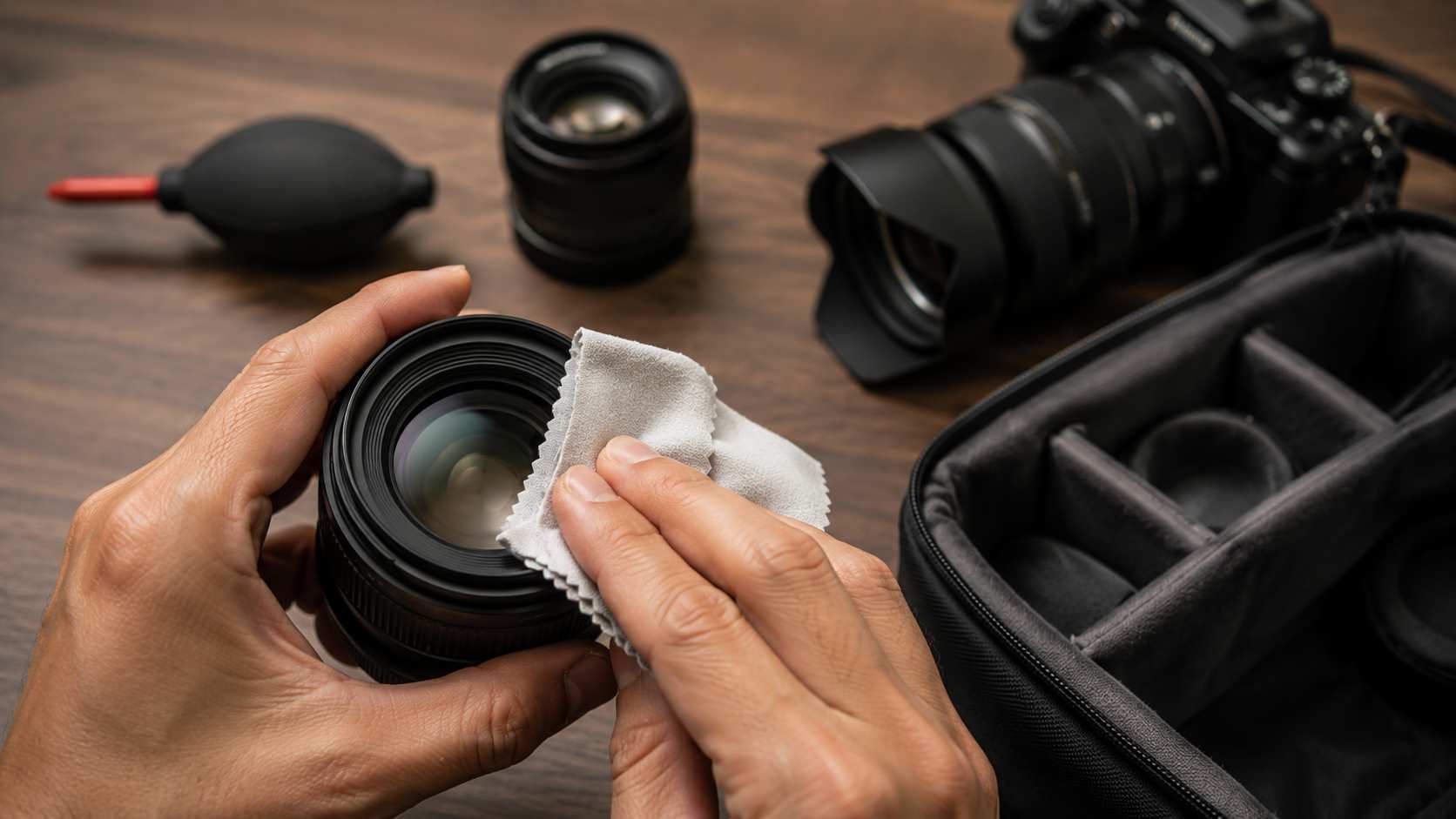
The most common cause of damage to a lens is somebody cleaning it. Coatings are thin and soft, dust is abrasive, and rubbing a dry cloth over a gritty front element grinds those particles into the glass. Meanwhile the dust itself, in the quantities found on a normally used lens, has no visible effect on a photograph.
What dirt actually does to an image
A few specks of dust on the front element sit far outside the plane of focus and are far too small to block a meaningful amount of light. They do nothing. Even a modest scratch is usually invisible in normal use.
What does show up is anything that covers a large area evenly. Fingerprints, smears, salt spray and haze scatter light across the whole frame, which reduces contrast and produces obvious flare when shooting towards a light source. That is worth cleaning. Individual specks are not.
Dust on the rear element matters slightly more than on the front, since it is closer to the sensor, but it still takes a great deal before anything is visible.
The order to clean in
- Blow first. A hand blower removes loose particles without touching the glass. Never use compressed air cans, which can spray propellant, and never blow with your mouth.
- Brush next. A soft lens brush lifts what remains. Keep it clean and do not touch the bristles with your fingers.
- Then wipe, if needed. A clean microfibre cloth, or a lens tissue, moved in a spiral from the centre outwards with very light pressure.
- Use fluid only if a dry wipe fails. Apply it to the cloth rather than to the lens, so it cannot run into the barrel.
The order exists because every stage that touches the glass is a risk, and removing loose grit first is what prevents scratches.
What to avoid
Household glass cleaner, alcohol wipes not intended for optics, kitchen roll, the corner of a shirt, and breathing on the lens then wiping it with whatever is nearest. Also avoid microfibre cloths that have been in a pocket or a bag loose, since they collect grit that then travels across the glass.
Do not attempt to clean inside a lens. Dust between elements is normal in any lens more than a few years old and has no practical effect. Opening a lens will almost certainly make it worse.
Fungus, and how to prevent it
Fungus grows on the microscopic residues on glass surfaces in warm, humid, dark and still conditions. It appears as fine branching threads, it spreads to other lenses stored nearby, and in time it etches the coatings permanently. It is the main reason old lenses become worthless.
Prevention is simple. Store lenses somewhere with moving air and moderate humidity rather than sealed in a bag in a cupboard. Let equipment dry fully before it goes away. Use silica gel sachets in bags and cases and dry them out periodically. Give lenses occasional exposure to daylight, since ultraviolet inhibits growth. In genuinely humid climates, a dry cabinet is a worthwhile purchase.
Caps, hoods and filters
A lens hood is the most useful protective accessory. It shades the front element from stray light, which improves contrast, and it takes the impact if the lens is knocked or dropped.
Protective filters are a longstanding argument. A good one costs a reasonable amount and protects against sand, salt spray and cleaning wear. A cheap one adds two more surfaces for reflections and can visibly increase flare. If you use one, buy a decent multicoated filter and remove it when shooting towards bright light.
How often to bother
Blow the front element when you notice dust and wipe it only when you can see a smear or a mark that covers area. Check for fungus every few months on lenses you rarely use, since those are the ones at risk. Beyond that, leave your lenses alone and use them, which is better for them than any amount of maintenance.